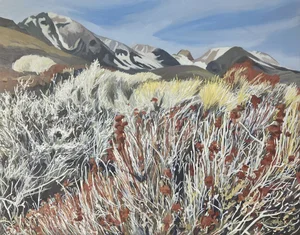
Homage to Payahuunadü
When I moved to the Owens Valley a few years ago I felt a deep affinity for this landscape that was nurtured over repeated visits, but I had only cursory knowledge of its history and ongoing struggle for ecological and cultural integrity. In the time that I have lived here, in addition to exploring the seemingly infinite places that one can think of to go, I have tried to learn about the past and present state of the region, in particular through the voices of its first inhabitants. By reading, watching documentaries, taking in lectures and discussions over Zoom and attending local events, I have begun to fill in the gaps and to see and appreciate what Payahuunadü, (the Paiute name for the Owens Valley) was and is.
I was always struck by the overwhelming presence of this land – two massive 14,000 foot mountain ranges flanking the deepest valley in the US, the vast sky that is the stage for a never ending drama of clouds and shifting light, and the inhospitable barriers of heat and rough terrain that render much of the landscape impenetrable in summer. This is what I came for, year after year. This impression of overpowering nature still remains, but my sense of this place has become far richer and more nuanced the more I have studied it.
What I have learned, most of all, is that this land has been home – a lifegiving, enduring home - for people for thousands of years, and that those first people are here still, caring for the land and sustaining the memory of what it once was. That the valley floor, which now appears to be mostly parched sagebrush, once brimmed with water and sustained cultivated fields of food crops. Before the arrival of European settlers, Bishop Creek watered 3,500 acres of cultivated land and Horton Creek watered over 9,000. The fields consisted of large terraces holding fine, rich soil, several feet deep. The canals and ditches were carefully calibrated so that the sediment they carried settled in the terraces and were not swept away. These extensive, complex water systems were in continuous use for at least 400 years beginning in the 14th and 15th centuries. They sustained the Nu-Mu, as the Paiute called themselves, the people that wove the exquisite baskets that you can see at the Paiute Shoshone Cultural Center in Bishop and the Museum of Eastern California in Independence, works of astonishing beauty and striking design. They who are today at the forefront of fights to protect the land from the destructive extraction of water and other resources.
As an artist I have drawn inspiration and nurture from this land for decades, so with deep respect I dedicate this exhibit to the vision of Payahuunadü as it was and is still in the memories and hopes of its Indigenous people, and to their current struggles to protect the land. As a more recent resident I acknowledge that I own and inhabit land that was taken from the Paiute people. How to hold this difficult truth and begin to address it in some way is a journey that I and doubtless many others around the country are embarking on.
Wherever that journey takes us, I think we can all agree that we are in a critical moment in our human story on this planet. We who live here in the Owens Valley are fortunate in that this particular place presents an opportunity to restore a deep and potent vision of humans living in reciprocal relationship with the land. The irony of the water theft by Los Angeles is that the valley itself remains remarkably free of development. It is suffering, the vegetation dying as the water table drops from too much pumping. But it is open, its surfaces not yet paved over. Restoration is imaginable. Let us keep the water and heal the land.
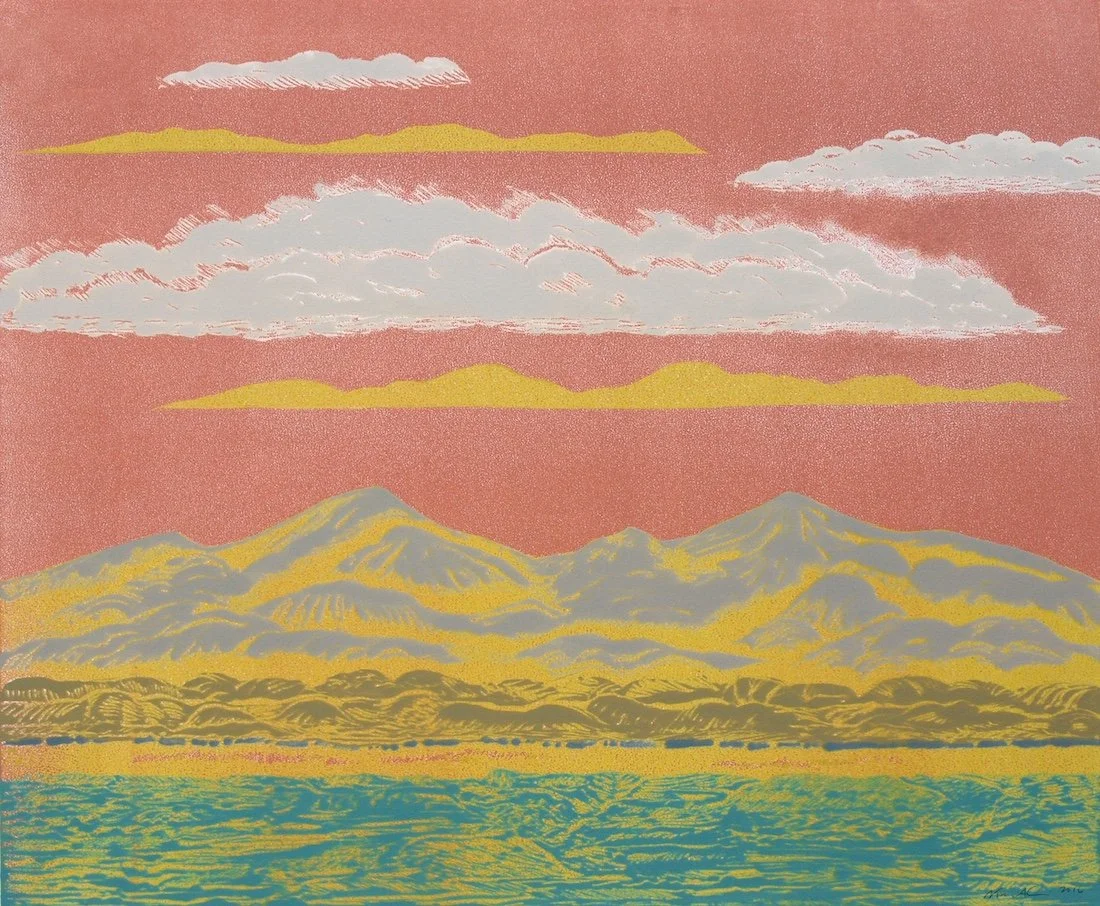
Homage to Payahuunadu, Monotype